

Introducing the peculiar world of the Soala - Hanya Awan
- wildliferescuesoci
- Aug 11, 2022
- 3 min read

As many perceive unicorns as fictional creatures, scientifically there is no evidence to prove that claim correct or incorrect. However, through years of research and recent sightings a new, mysterious, unpredictable creature has been sighted and has been compared to a unicorn. This mysterious and unknown species that is currently researched and investigated worldwide is named the “Soala.” These animals are identified to be a specific species of Antelope that is locally discovered in forests on the border of north-central Vietnam and Laos. They are among the most recently discovered large mammals in the world but are also thought to be one of the rarest, with a population estimated at only a few tens of individuals remaining in the natural habitat in Vietnam and Laos. Despite their resemblance to Arabian Desert Antelopes, Soala are thought to be closer to wild cattle. After their discovery in 1992, the Soala was given its taxonomic group for their distinctive and unique characteristics. Despite their rarity and elusiveness, extraordinarily little is investigated about the Soala. In addition to the long horns, the Soala is further labelled as the “Asian Unicorn,” which is more due to its rarity than anything else. The Antelope species known as a Soala has long, sharply pointed horns that sit parallel on top of the animal’s head, making it one of the most distinctive in the world.

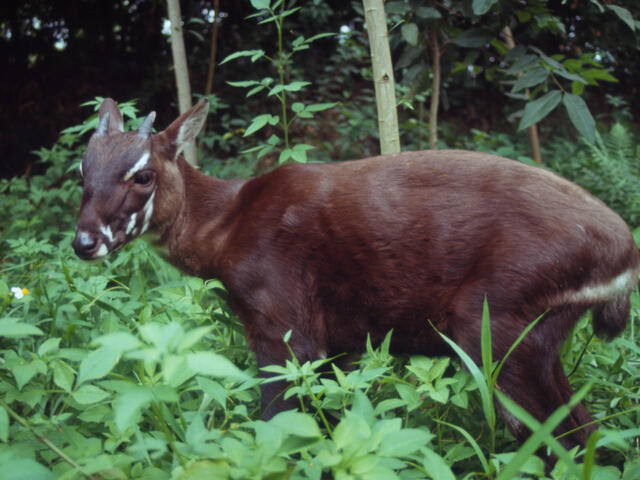
These smooth horns are evident on both males and females of the species and can grow up to 50cm (about 1.64 ft) in length. A soala’s body varies in colour from chestnut brown, to red, to almost black, with a dark, narrow stripe running along the back and a small and fluffy tail. The legs of the soala are additionally black in colour but it is on their face that their most distinctive white markings are found. It is believed that Soala’s thin and soft fur protects them from being injured too severely by other animal’s horns due to the fact that their thick skin bodies their thin and delicate fur. Despite the fact that they are believed to exist in certain areas, no one is truly assured due to a lack of formal surveys. However, they have been observed in 15 small pockets of forests between the two nations (Vietnam and Laos), generally at mid-altitudes (between 400 meters (about 1312.34 ft) and 1,000 meters (about 3280.84 ft) above sea level). The Soala is most commonly found in dense, evergreen forests that are moist and have a consistent source of fresh running water.
Moreover, the Soalas spend their summer months further up the alpine slopes, venturing down during the winter when the water sources higher up run dry and there is less food available. According to the IUCN, Soalas are critically endangered in their natural environment. In spite of the fact that no formal survey has been conducted, the IUCN estimates that the Soala population may have been as low as 250 when it was first recorded in 1992, a number that is thought to have decreased significantly since then due to the increased growth of human settlements. In the Indochina region, WWF claims that the Soala is one of the most critical species to conserve due to its rarity, distinctiveness, and uniqueness. In Quang Nam province in central Vietnam, a small 61 square mile reserve has been created to protect the dwindling Soala population. In fact, almost all of the relevant information on the Soala comes from 13 individuals who were held in captivity (6 in Vietnam and 7 in Laos) after their discovery and from local villagers. However; in pure devastation, all but two of the remaining specific Soala died whilst being studied by researchers.
Currently, there are no Soala discovered in captivity anywhere in the world as they do not seem to survive at all in well conditions outside of the conditions that they have naturally adapted and evolved to. Overall, these animals cannot be hunted since they are a protected species, though they frequently have been caught in snares and traps that are placed in the forests where they live. The prime objective of this is to capture deer and wild boar. Despite this, significant work is being performed across a substantial portion of their natural range to be certain that they are commonly detected in regions of protected forest that are less vulnerable to hunting and poaching. Thus, the mysterious Asian “unicorn” is gradually becoming more vulnerable and targeted by other wild predators and human activity.
Works Cited A-Z-Animals.com. “Saola.” A-z-Animals.com, 2018, a-z-animals.com/animals/saola/. https://www.facebook.com/thoughtcodotcom. “Unknown Saola Facts.” ThoughtCo, 2019, www.thoughtco.com/profile-of-the-endangered-saola-1181994. “Saola | Species | WWF.” World Wildlife Fund, 2000, www.worldwildlife.org/species/saola. What Is a Saola? – the Saola Working Group. www.savethesaola.org/what-is-a-saola/.



Comments